Sequence Mapping in Dice Games Creates Interactive Probability Workshops That Channel Proceeds Toward Urban Garden Initiatives
Viktor Simmons · Aug 11, 2026
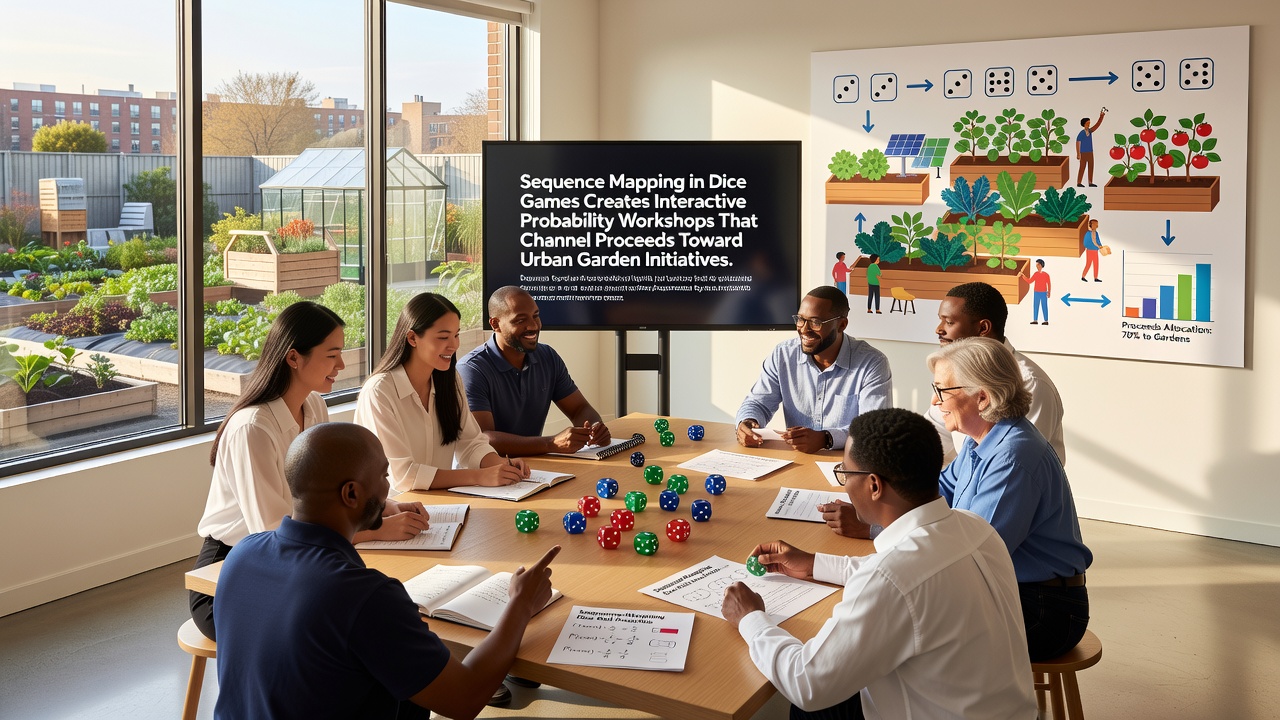
Sequence Mapping in Dice Games Creates Interactive Probability Workshops That Channel Proceeds Toward Urban Garden Initiatives
Sequence mapping in dice games involves charting numerical patterns and outcome probabilities through repeated rolls, and this approach has gained traction in educational settings where participants learn statistical concepts while generating funds for local projects. Researchers at various institutions have documented how structured dice activities turn abstract math into tangible experiences, with proceeds directed toward urban garden initiatives in several cities.
Understanding Sequence Mapping Techniques
Participants track sequences such as consecutive numbers, paired results, or cumulative sums across multiple dice rolls, and these records reveal distribution patterns that align with established probability principles. Data from academic studies shows that visual mapping tools help groups identify recurring clusters or rare streaks, which in turn supports discussions on expected values and variance without requiring advanced equipment.
Community organizers often combine standard six-sided dice with custom variants that include additional faces or weighted elements, and this flexibility allows workshops to scale from small neighborhood gatherings to larger events. Observers note that the method draws on core concepts taught in mathematics curricula, yet adapts them for hands-on formats where each roll contributes to a shared dataset.
Workshop Structure and Participation
Facilitators divide sessions into phases that include an introduction to mapping grids, guided practice rounds, and group analysis of collected results, and these steps keep engagement high across different age groups. In practice, attendees record outcomes on shared boards or digital interfaces, then compare findings against theoretical models derived from large-sample simulations.
August 2026 saw several such workshops expand in mid-sized urban centers, where attendance figures reached several hundred per event according to local reports. Those who have studied similar programs indicate that retention improves when mapping exercises tie directly to real-world applications like resource allocation in community projects.

Directing Funds to Urban Garden Initiatives
Entry fees and optional contributions collected during workshops flow into dedicated accounts that support soil preparation, seed distribution, and irrigation systems for neighborhood green spaces. Municipal records from multiple regions demonstrate that these micro-funding streams supplement larger grants, and the connection between probability education and garden development creates a visible loop where participants see outcomes from their involvement.
Groups in several states have adapted the model to include themed mapping challenges that correspond to garden layout planning, and this integration encourages repeat attendance while maintaining focus on statistical accuracy. Evidence from educational evaluations suggests that linking abstract concepts to physical results strengthens both learning retention and community investment.
Regional Examples and Data Trends
Programs operating in the Midwest have reported consistent turnout increases during summer months, with mapping sessions often paired with harvest events that highlight produce grown from prior funding cycles. A report issued by the Urban Institute outlines how small-scale gaming activities contribute measurable support to local agriculture efforts across diverse neighborhoods.
Meanwhile, Canadian researchers tracking similar initiatives through the Statistics Canada community development surveys have noted parallel patterns where probability-based workshops generate steady revenue streams without overlapping existing charity frameworks. These findings emphasize the scalability of sequence mapping as an accessible entry point for groups seeking low-overhead educational programming.
Implementation Considerations for Organizers
Successful setups rely on clear rules for data collection, neutral facilitation to prevent disputes over outcomes, and transparent accounting for all proceeds. Equipment needs remain minimal, typically limited to dice sets, mapping sheets, and basic tally systems, while venues range from community centers to outdoor spaces adjacent to existing gardens.
Training materials developed by mathematics education networks stress the importance of aligning session length with attention spans, and many programs incorporate breaks that double as opportunities to discuss garden progress updates. This layered approach keeps the focus on both skill-building and tangible community benefit.
Conclusion
Sequence mapping applied to dice games offers a structured pathway for probability education that simultaneously supports urban garden initiatives through targeted fundraising. Continued documentation from research bodies and local agencies will clarify long-term impacts on both participant understanding and green space development across participating regions.